
Tom Clancy’s The Division: Heartland - AAA (Unreleased)
Ubisoft: Red Storm Entertainment
Snowdrop Engine | Team of 120 | Aug. 2023 - May 2024
I joined the Heartland project in August 2023 as it was going through its third and final genre pivot from a PvEvP F2P TPS to a boxed product survival shooter. I quickly learned Snowdrop Engine by reverse-engineering the existing systems in the game, then used what I learned to prototype new systems and 3C’s changes. Additionally, I constantly playtested and gave feedback on other features, coordinated playtests with User Research, acted as a liaison between design and Quality Assurance, and wrote design and technical documentation in Confluence that became a template for other developers to use.
Top Skills
System Design, 3C’s Design, Combat Design, Balance Design, Visual Scripting, Coding (Proprietary Language), Perforce, Excel, Jira, Confluence, Miro, Powerpoint, Agile Methodologies, Public Speaking
More Heartland Work Available in Locked Content
Tuned Combat and Survival Systems to Change Game Genre
Learned implementation of Heartland systems in Snowdrop inside and out: where everything lived, what was a data change, a code change, visual scripting, or UI graph.
Researched real-life wilderness survival and performed competitive analysis of survival games. Researched all weapons (many guns) present in Heartland.
Set and iteratively tuned most data values in the game:
weapon damage at tiered ranges
player and NPC health
player stamina and new survival systems values
player and NPC armor
in Snowdrop to achieve “every bullet counts” survival game feel. This involved establishing design assumptions for TTK and survival 3Cs, documenting the above values and where to change them (Snowdrop files) in Excel, and creating one source of truth by creating new design documents and marking deprecated ones.
When I joined Red Storm, I immediately formed tight relationship with Quality Assurance, providing updated values and expected outcomes to reduce false bug reports and confusion. I became their go-to for design questions for the remainder of the project.
Designed and Prototyped New Survival System
Worked on feature team as technical designer with 2 programmers and 1 technical UI artist, reporting to Lead Game Designer.
Began work on feature with competitive analysis and design ideation, aiming to reuse as much of the existing Water/Satiation/Fatigue system as possible.
Worked with Lead Game Designer to approve final design and set actionable goals for team.
Coordinated code changes for 3C’s, setting up ways to tune feature in the future with data-only changes.
Collaborated with UI artist to completely redesign player inventory interface.
Set, tuned, and documented all values for New Survival System.
Set all values for player stamina system and new status effect, owning until project end.
Created 3 panel system in-game description for New Survival System.
Wrote and maintained design documentation for New Survival System in Confluence.
Wrote test cases for User Research lab.
Raised player perception (User Research playtests with hardcore The Division fans) of New Survival System from “Dissatisfactory” with previous version to “Indifferent” with first iteration of New Survival System to “Highly Satisfactory” with final New Survival System version.
Remained SME for New Survival System for remainder of the project.
Designed and Prototyped New Melee Combat System, Creating Emphasis on Stealth
With the mandate “every bullet counts”, melee needed to be a reliable and strong choice. The work started with me brainstorming new Melee Combat with the Associate Game Director. Then a development team was formed with myself and two other technical designers, the two game directors, two gameplay programmers, an animator, a UI technical artist, and a producer.
We collaborated in brainstorming meetings, talking on Teams while I mapped out the new system in Miro. I’d provide design feedback and a TD’s perspective on scope and engine constraints.
We designed 3 melee attacks: A “buttstroke”, the player using their gun as a melee weapon; a “normal”, where the player uses an equipped melee weapon to attack an aware NPC; and “stealth”, a “normal” melee attack performed on an unaware NPC, which was always lethal unless the NPC was wearing a helmet.
Paper Design for New Melee Combat I Created in Miro
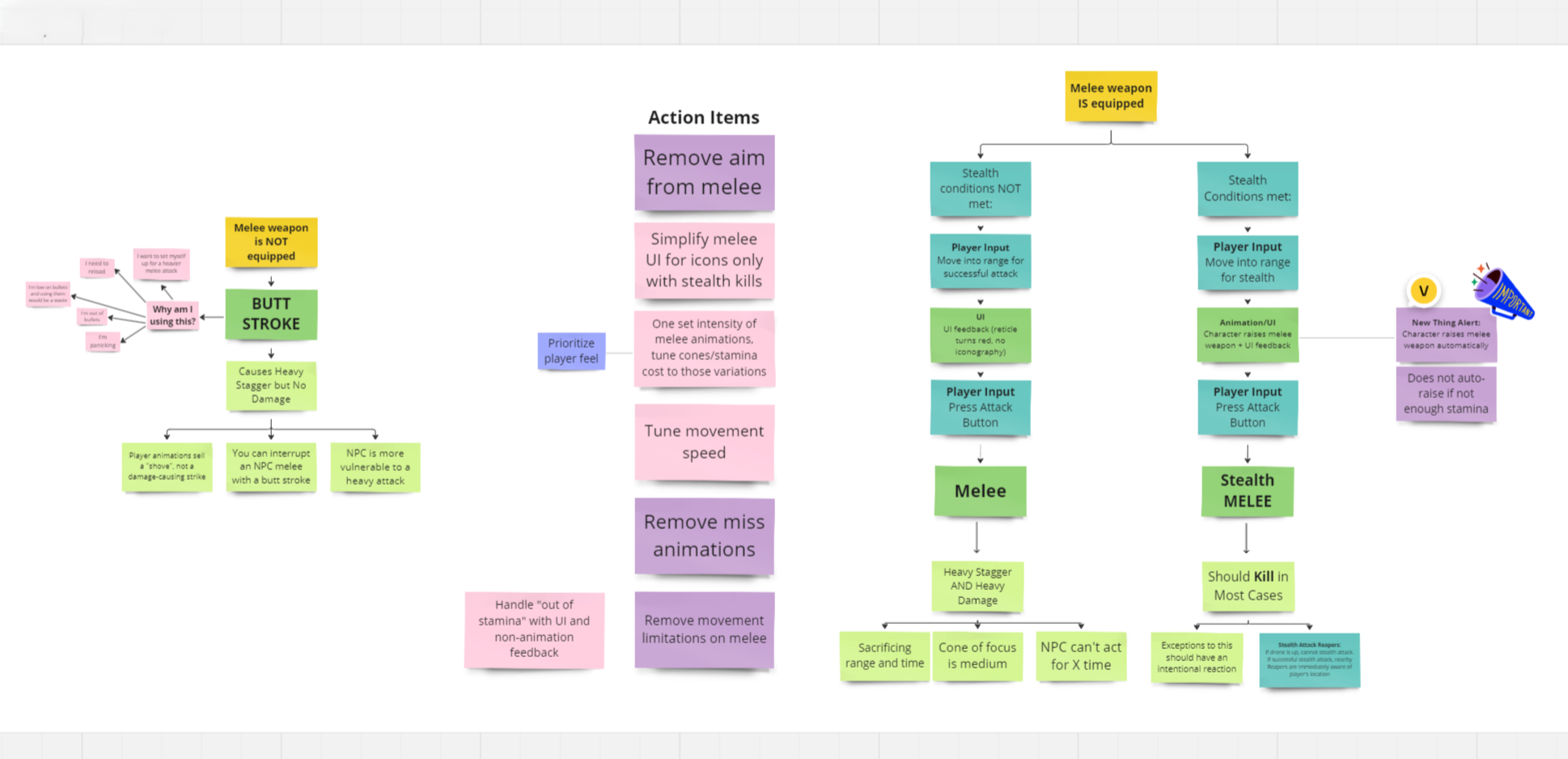
Once the paper design was complete, we split the work. My focus was on the player’s experience.
My time in-engine was spent creating the logic and tuning the 3C’s, stamina, stealth, and damage values to be different for the three melee attacks. I’d modify data and visual scripts to make iterative changes to how the three different versions of melee felt. This meant a lot of close collaboration with animators as they made changes to the animation graphs, programmers who I’d work with to add new variables/design levers for me to pull and remove existing melee assumptions from our Division branch of the engine, and our Lead NPC Designer who owned everything “melee reaction.”
I also acted as SME for Melee Combat for the remainder of the project.
Implemented and Tuned Game Difficulty Settings
Implemented difficulty settings for the game within Snowdrop.
Set debug commands for difficulty settings; Coordinated new Difficulty Settings menu with UI team.
Set and iterated on the following values for three difficulty settings.
what % of damage NPCs do compared to players with same weapon
how many NPCs spawn in an encounter
how much health NPCs have
how accurate and intelligent NPCs are
Wrote User Research test cases and playtest survey questions, parsing feedback against the players’ determined skill levels.
Public-Facing Systems SME
Acted as SME for Combat, New Survival Systems, Game Difficulty settings, to other developers, User Research, and Quality Assurance.
Was a go-to for impromptu questions about these systems or pretty much anything in the game. When someone was onboarded to the project post-January, I’d give an intro to our game’s systems, a Snowdrop learning session and show them where to find documentation.
Presented at 5 multi-studio project updates (delivered a PowerPoint presentation I created to 300+ people on a recorded Teams call.) I used humor to sell our teams’ designs and encourage participants to playtest the game. One moment ended up making the sizzle reel for entire 5+ year Heartland project, which was a huge honor.
Redefined Game Design Documentation at Red Storm
My first month at Red Storm, I created a Game Design Document for the New Survival System I’d designed and implemented in Confluence. This included a brief summary of the feature and sections for each of the system’s mechanics. The mechanics section went very in-depth, line by line through the player’s experience.
For each step, all aspects of that feature were accounted for (from UI to 3C’s to audio), and gameplay values that needed to be quickly iterated were identified (for example: vaulting costs the player [30] stamina).
We also had tags for each of these aspects that corresponded to their current Jira status. We knew what should be done and playtested as such, and what wouldn’t be present in that day’s build.
This documentation also contained a technical documentation section at the bottom that was linked to throughout the design documentation. If someone reading the design documentation wanted to know where to tune values they were reading about, they just had to click on them. If they didn’t want the technical documentation, they didn’t have to see it.
This documentation was helpful for many reasons: it made the design’s intentions and definition of “success'“ for tasking incredibly clear to the feature’s developers; it communicated the design beyond the team to other developers, User Research, and Quality Assurance, ending “is it a bug or a feature?” for the New Survival System; and it drastically improved the efficiency of onboarding a new dev onto the team. The documentation handled what I used to need two weeks of Teams call to figure out.
The positive impact was noticed by our production leads, who made the New Survival System page into a Confluence template and initiated an overhaul for all of our system design documentation to follow it. This template was still used past the end of the Heartland project, on other projects.